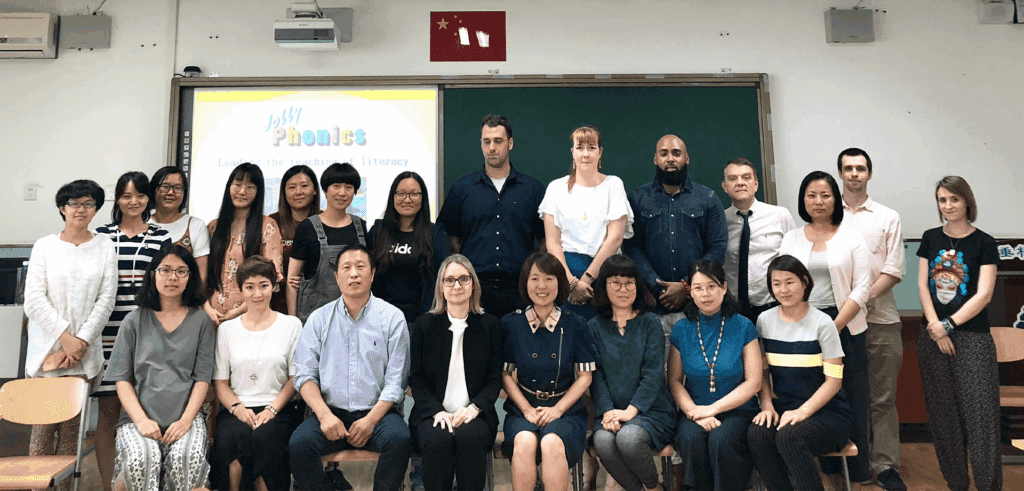
In 2023, GPLRC was commissioned by the Beijing Municipal Education Bureau to deliver a comprehensive Synthetic Phonics Teacher Training Programme for primary school English teachers across Beijing. This initiative aimed to elevate early English literacy by equipping educators with systematic, research-based synthetic phonics methodologies adapted to the linguistic and cultural context of Chinese urban classrooms.
Project Objectives
- Deepen teacher understanding of the science of reading, phonemic awareness, and grapheme–phoneme correspondence (GPC).
- Develop practical instructional skills for explicit, systematic synthetic phonics teaching tailored for large, diverse classes.
- Enhance student decoding, blending, and reading fluency, laying strong foundations for ongoing literacy development.
- Build sustainable local capacity through resource provision, mentoring, and professional learning communities.
Detailed Training Components and Methodology
1. Intensive, Research-Based Workshops (3 days)
- Day 1: Theoretical Foundations
- Overview of the cognitive science underpinning phonics instruction.
- Phonemic awareness as a prerequisite for reading success.
- Introduction to English phoneme inventory and its challenges for Chinese learners.
- Day 2: Synthetic Phonics Teaching Skills
- Explicit instruction techniques for teaching letter-sound relationships.
- Multi-sensory methods incorporating visual, auditory, and kinesthetic learning modalities.
- Lesson structuring: introduction, guided practice, independent practice, and review cycles.
- Differentiation strategies to meet the needs of learners with varying proficiency and learning styles.
- Day 3: Assessment and Data-Driven Instruction
- Formative assessment tools for tracking phonics mastery and identifying struggling readers.
- Data analysis for tailoring instruction and interventions.
- Integrating phonics assessment into everyday classroom practice.
2. Model Classroom Lessons and Interactive Demonstrations
- GPLRC experts conducted live lessons in Grade 1 and 2 classrooms involving:
- Use of decodable texts aligned to phonics progression.
- Interactive phonics games to reinforce sound-letter mapping and blending.
- Formative questioning techniques to check understanding and promote active participation.
- Teachers observed these model lessons followed by debrief discussions to reflect on instructional strategies, classroom management, and student engagement.
3. Micro-Teaching Sessions with Video Feedback
- Each teacher delivered mini phonics lessons to peers, recorded for review.
- Trainers used GPLRC’s Phonics Instruction Observation Rubric evaluating clarity, pacing, student engagement, and use of multi-sensory cues.
- Detailed, personalized feedback supported skill refinement and confidence building.
4. Provision of Tailored Teaching Resources
- Custom-designed phonics packs including:
- Decodable readers featuring culturally relevant content.
- Flashcards and sound mats for classroom use.
- Comprehensive lesson plans and pacing guides.
- Assessment checklists and student tracking sheets.
5. Post-Training Support and Mentoring (2 months)
- Biweekly online mentoring sessions provided:
- Group problem-solving and strategy sharing.
- Individual lesson plan review and troubleshooting.
- Video lesson analysis with constructive critique.
- An online forum facilitated ongoing peer support and resource sharing.
Challenges Addressed
- Large class sizes and mixed ability levels: Training emphasized differentiated instruction and classroom management techniques suited to Beijing’s typical urban schools.
- Limited prior phonics exposure: Teachers often had experience with vocabulary teaching but lacked structured phonics knowledge; the programme filled this gap with scaffolded instruction.
- Language transfer issues: Special attention was given to common pronunciation difficulties for Chinese speakers, including strategies to support phoneme discrimination and production.
- Resource constraints: Emphasis on low-cost, easily reproducible materials ensured sustainability.
Impact and Outcomes
Teacher Capacity
- Post-training evaluations showed:
- 100% of participants reported increased confidence in phonics teaching.
- Average rubric scores improved from 62% pre-training to 88% post-training, indicating substantial gains in pedagogical skill and lesson delivery.
- Teachers reported improved classroom engagement and ability to manage diverse learners.
Student Literacy Gains
- Within one semester, students taught by trained teachers demonstrated:
- An average increase of 23% in letter–sound knowledge.
- A 19% rise in accurate decoding of CVC and more complex words.
- Observable improvements in oral reading fluency and self-correction.
- Enhanced motivation and positive attitudes toward reading English.
Systemic and Sustainable Changes
- Three Beijing schools officially incorporated GPLRC’s synthetic phonics scope and sequence into their English curriculum frameworks.
- Teacher leaders appointed as phonics mentors to cascade training and support within their schools.
- The creation of a city-wide phonics professional learning community facilitated by GPLRC, ensuring continued collaboration and development.
Participant Testimonials
“The hands-on training and continuous mentoring helped me move beyond vocabulary teaching to actual reading instruction. My students are reading more confidently and enjoy our phonics lessons.”
— Primary English Teacher, Beijing
“The detailed feedback on my micro-teaching videos was invaluable. It helped me identify areas for improvement and build real classroom skills.”
— Workshop Participant
GPLRC’s Professional Role
Demonstrated a proven model for scalable phonics teacher training in urban China.
Delivered state-of-the-art, research-aligned phonics pedagogy tailored for the Chinese context.
Combined theory, practical application, and ongoing mentoring to ensure effective skill acquisition.
Provided locally relevant teaching materials and data-driven assessment tools.
Fostered community and leadership through capacity-building and peer collaboration.
 Global Phonics And Literacy Learning And Research Centre